
Washington County Court Records After Arrest
A Washington County jail arrest starts a custody record, but the court record begins when a criminal case is filed or updated in Idaho's court system. After booking, the person may appear before a magistrate. The prosecutor then decides what charges to file, whether to amend or dismiss a charge, and how the case should proceed. The Washington County Prosecuting Attorney's Office prosecutes felony and misdemeanor crimes, juvenile delinquency, and infractions. Its official pages cite Idaho Code 31-2604 duties for felony actions, misdemeanor and infraction matters, preliminary examinations, and drawing informations or indictments where required.
The custody side and the court side should be checked together. Use Washington County jail inmate records to confirm current custody or booking clues. Use Idaho iCourt for the formal case. Use Washington County jail mugshots only for booking-photo questions, because court filings usually do not provide a mugshot gallery. A booking charge is an intake label; a filed court charge is the prosecutor's formal accusation, and it can differ from the initial arrest label.
Find Washington County Court Records After Arrest
The official court search route is the Idaho iCourt Odyssey Portal. The iCourt overview says public users do not need to register for public access, while extended access requires registration and approval. Washington County moved into iCourt in Wave 2 on April 9, 2018. That date matters for older record searches because the portal may not show every older paper detail in the same way as current electronic cases.
- Search the Washington County In Custody roster for the exact name spelling and arrest date.
- Open iCourt Smart Search and search by party name or case number if one is known.
- Limit review to Washington County criminal cases when common names return records from other counties.
- Open the case summary and read filing date, charges, hearing dates, case status, and disposition fields.
- Compare the booking date to the court filing date. The court record may appear after the jail roster row.
- Use the clerk or court route for certified copies, extended access, or older paper files.
Washington County Court Search Fields
Idaho iCourt search tools are broader than the jail roster. They search court records, not jail custody. Smart Search can use party names, case numbers, and related record terms. Hearing searches can help when a person knows the court date but not the case number. Extended access exists for approved users, but public users should expect some limits for confidential, sealed, juvenile, or protected information.
| Field / Mode | Type | Required | Notes |
|---|---|---|---|
| Smart Search | Text | Yes for search | Search by party name, case number, or terms. |
| Search Hearings | Text/date filters | Varies | Finds hearing information. |
| Case number | Text | Optional | Best when found from paperwork, the clerk, or a records request. |
| Party / defendant name | Text | Optional | Use spelling variants and check middle names. |
| Case type/status filters | Dropdown/filter | Optional | Exact portal controls may vary. |
| Extended Access | Account workflow | Only for eligible users | Registration and approval required. |
Washington County Prosecutor's Role
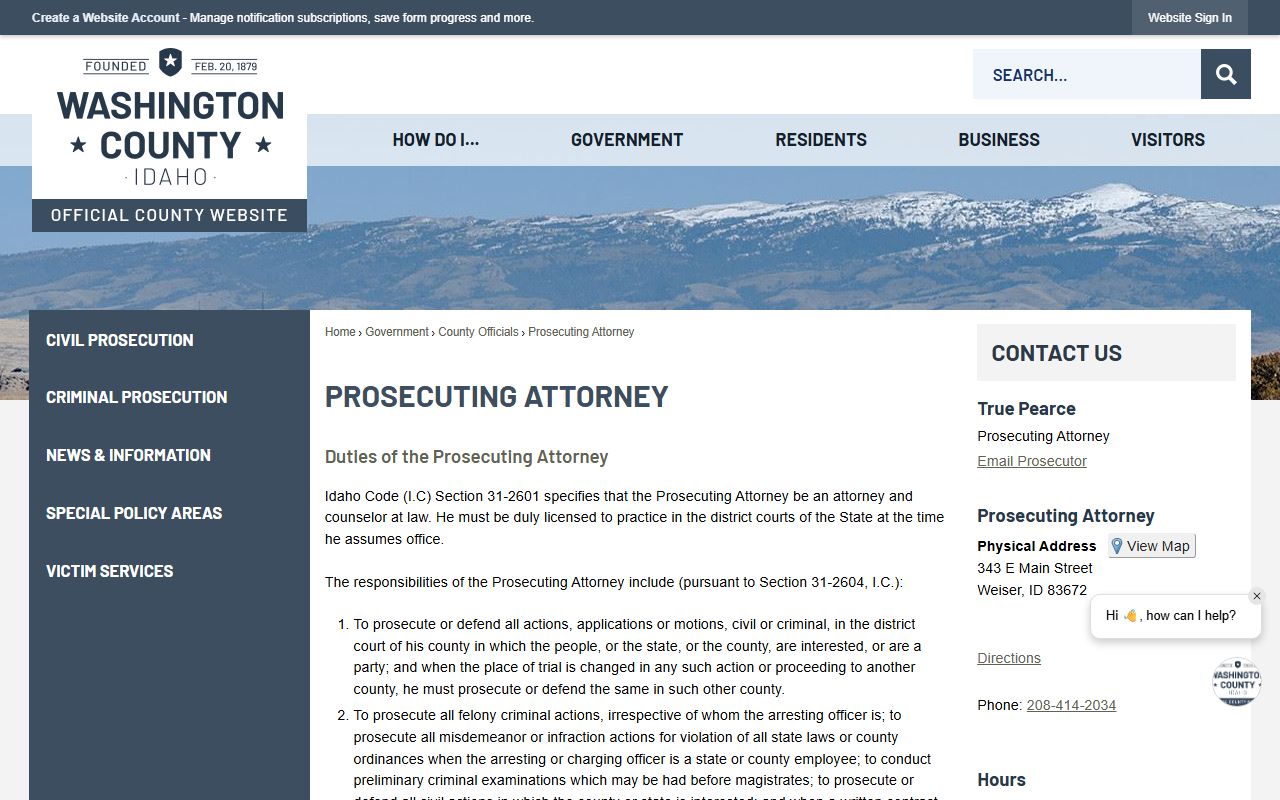
Washington County Prosecuting Attorney True Pearce is listed on the county prosecutor page. The office address is 343 E Main Street in Weiser, and the phone is 208-414-2034. Published hours are Monday through Friday, 8:30 a.m. to 5 p.m. The prosecutor's criminal-prosecution page explains that the office prosecutes felony and misdemeanor crimes, juvenile delinquency, and infraction cases. That is the office that turns a post-booking matter into a filed criminal case when charges are pursued.
The Washington County Prosecuting Attorney page screenshot is relevant to court records after a jail arrest because it identifies the office responsible for filing and pursuing charges.
Victims, defendants, and families should not use the prosecutor page as a jail release source. Jail custody is confirmed through the jail, while case events are confirmed through iCourt or the clerk.
Charging Documents After Arrest
After a Washington County arrest, charges may appear through several document types. A complaint is often used early in a case. An information is a prosecutor-filed formal charge, commonly after the probable cause or preliminary stage. An indictment is returned by a grand jury. The terms sound similar, but they show different ways a criminal case can be started or carried forward.
| Document | Who Uses It | What It Means |
|---|---|---|
| Complaint | Officer or prosecutor | Early charging paper often used to begin a criminal case after arrest. |
| Information | Prosecutor | Formal prosecutor-filed charge after probable cause or preliminary process. |
| Indictment | Grand jury | Grand-jury charging document used in some serious cases. |
Washington County Charge Status
Charge status can change after the first court record appears. A charge may be pending, amended, reduced, dismissed, or resolved by plea or trial. The booking charge on a jail record may not match the final filed charge. A dismissal also does not automatically erase the booking record or every public trace of the case. Sealing or expungement depends on Idaho law, court orders, and case type.
| Status | Plain Meaning |
|---|---|
| Pending | The charge is active and the case has not reached final disposition. |
| Amended | The prosecutor or court changed the charge language, level, or count. |
| Reduced | The charge was lowered to a less serious offense or level. |
| Dismissed | The charge ended without a conviction on that count. |
| Convicted | A plea or finding resulted in a judgment on the offense. |
Bond After a Washington County Arrest
Washington County's public jail page does not publish a detailed bond-payment page, accepted payment methods, bond desk hours, or a local bail schedule. The safest sequence is to confirm custody on the roster, call Washington County Jail at 208-414-2124, and then check iCourt once the case appears. A warrant portal result may show a bond amount, but a court order, agency hold, probation/parole detainer, IDOC hold, ICE hold, U.S. Marshals hold, or another-county case may prevent release even when a local bond exists.
| Release Type | How It Works |
|---|---|
| Cash bond | The full amount is paid to satisfy a court or jail release condition. |
| Surety bond | A licensed bail agent posts a bond for a nonrefundable fee. |
| Own recognizance | Release based on a promise to appear and comply with conditions. |
| No-bond hold | Money will not release the person until a court or agency changes the hold. |
| Detainer | Another agency requests or requires continued custody. |
Warrants and Court Records After Arrest
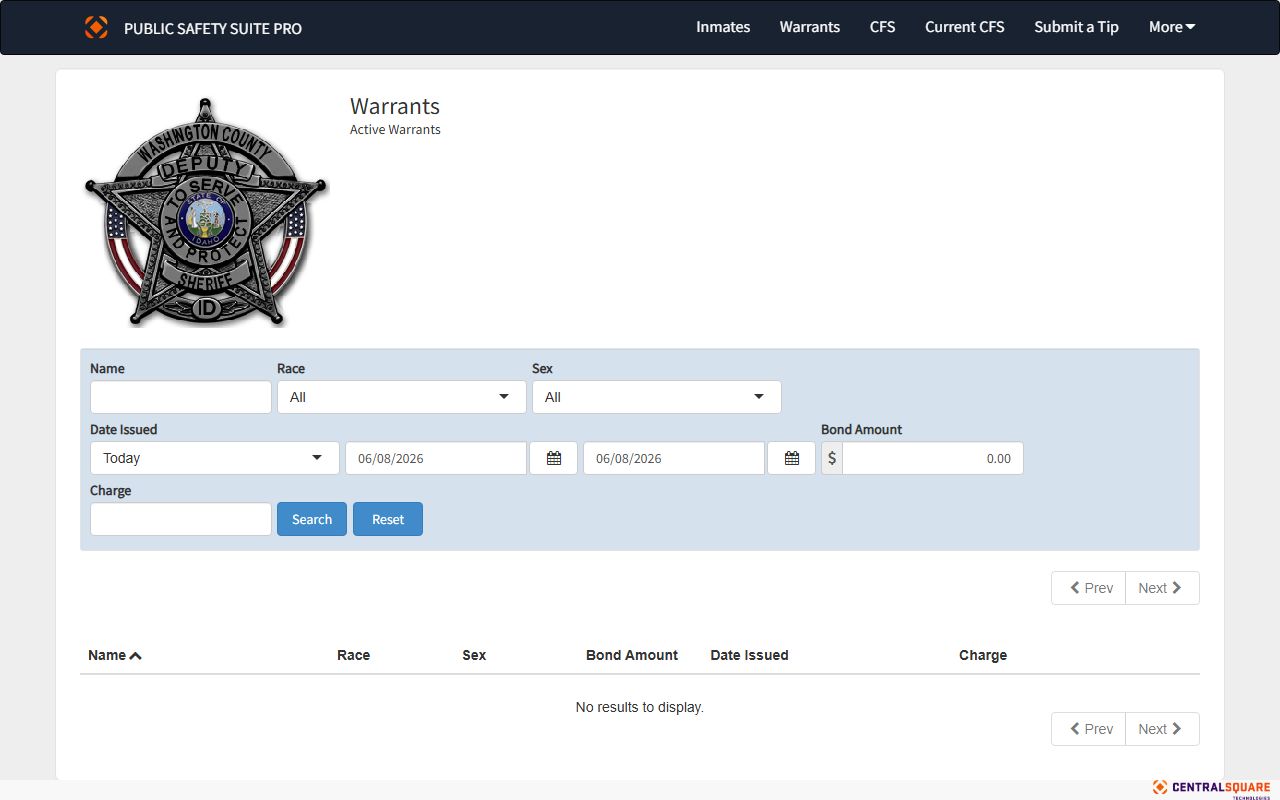
Washington County's jail page links the official Zuercher Active Warrants portal. The warrant configuration requires at least one non-default criterion and includes fields for name, race, sex, date issued, age, bond amount, and charge. A warrant may be the reason for a jail arrest, or it may arise later from a failure to appear. Bench warrants and failure-to-appear issues should be checked against the iCourt case and handled through the court or counsel, not by relying on a web result alone.
The Washington County active-warrant search screenshot shows the county's official warrant interface tied to arrests, bond amounts, and charges.
Call the sheriff's dispatch/main line at 208-414-2121 or the jail at 208-414-2124 for warrant and custody routing when an arrest or appearance is imminent.
Charges vs Convictions
A charge is an accusation filed or pursued in court. A conviction is a judgment after a plea, verdict, or other qualifying disposition. Court records after a jail arrest can show both, but they should not be treated as the same thing. Pending charges may be amended or dismissed. A conviction may also be followed by probation, jail time, prison, fines, treatment, or other terms.
| Point | Charge | Conviction |
|---|---|---|
| Stage | Accusation or filed count | Final finding or plea outcome |
| Proof | Probable cause or charging decision | Legal finding beyond the accusation stage |
| Record use | Shows what was alleged | Shows what was adjudicated |
Sealed and Expunged Court Records
Idaho Court Administrative Rule 32 governs public access to Idaho court records and related limits. Idaho Title 19, Chapter 49 provides sealing and expungement context for certain criminal-history and court-record relief. Eligibility depends on the case type, outcome, age, offense, and order entered. A dismissed charge or amended case does not by itself guarantee that every jail, court, or criminal-history record disappears from public view.
| Record Action | Public Effect | Important Limit |
|---|---|---|
| Sealed | Hidden or restricted from ordinary public access. | Some agencies or courts may retain limited access. |
| Expunged | Removed or treated under a specific relief statute. | Not available for every case or charge. |
| Redacted | Specific protected details are removed. | The rest of the record may remain public. |
Public Access Rules After Arrest
For jail and law-enforcement records, Idaho Code 74-102 presumes public access unless another statute applies. Idaho Code 74-103 governs response timing and copying, and Idaho Code 74-105 contains law-enforcement and correctional exemptions. For court records, use Idaho court access rules and iCourt. These systems can restrict juvenile records, sealed cases, confidential victims or witnesses, medical or mental-health details, active investigations, and security-sensitive jail information.
Important: Court, jail, and criminal-history records must be verified with the agency or court that created them before any legal decision.
Criminal History vs Court Docket
The Idaho State Police Bureau of Criminal Identification is the statewide criminal-history repository and background-check channel. That is different from iCourt. iCourt tracks public case events, charges, hearings, and dispositions. BCI handles criminal-history/background-check processes. For employment, housing, credit, tenant screening, insurance, or other FCRA-covered use, use a lawful consumer-reporting process instead of a casual web lookup.
Public Record Search
Sponsored Results